



How Do Escalators Work?
Aug 08, 2026
Leave a message
With continuous economic development, urban infrastructure has become increasingly sophisticated. Previously, we only saw elevators and escalators in big cities; now, we can find them even in supermarkets in small towns. But do you, a frequent escalator rider, understand how they work? We often hear about escalator accidents causing injuries. Why are Crocs, commonly worn in summer, such a favorite target for escalators? What exactly is the purpose of the yellow lines on escalators?
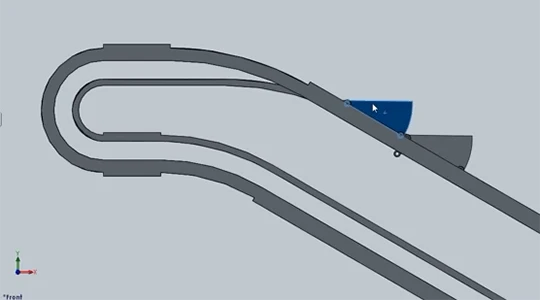
Working principle of escalators
Escalators consist of a series of individual components, including trusses, drive mechanisms, guide rail systems, step chains, and various safety devices . All components and safety devices are housed within a robust metal frame known as a truss .
In simple terms, the main components of an escalator are gears on both sides and a track covering them . The track has a row of rollers on both sides for better sliding. The gears have a mechanism similar to a bicycle chain, whose main function is to make the smaller gear drive the larger gear. The larger gear engages with the inside of the track, so when the gear starts to rotate, the track will also circulate. The track itself is the metal step we stand on, with neatly arranged grooves, partly for anti-slip purposes and partly to engage with the comb plate at the end.
These metal steps are not solid, but rather small iron shells shaped like steps, forming a triangular structure . This allows the steps to overlap at the points of rotation, transforming the high and low steps into ordinary curved surfaces, thus preventing them from getting stuck during cyclical movement.
Why can't you ride an escalator while wearing Crocs?
To answer this question, we first need to understand the characteristics of Crocs. Crocs have a wide toe box (about 20% wider than normal shoes). To ensure comfort, the plastic in Crocs is very thick, and the upper is very high. Therefore, even when standing in a normal position, the toe box is much closer to the serrated edge between two escalator steps than in normal shoes. At the same time, because the friction between the plastic sole and the foot is insufficient, the habit of standing normally causes the shoe to shift forward. Combined with the relatively high friction between the plastic and the escalator, it is not easy to notice when the shoe gets caught. This means that by the time you feel your foot, it is already too late to pull it out.
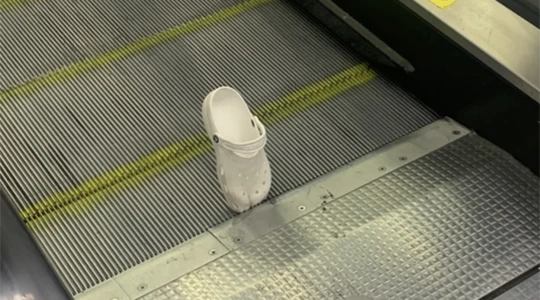
Simply put, the soft material of Crocs makes them prone to sticking to metal or other surfaces when they rub against each other. If you don't lift your foot in time, they can easily stick to the front and side escalator steps , causing them to get caught and get into the gap between the steps and the skirt board.
The reason escalators are prone to causing injuries is that they are designed with certain gaps. These gaps mainly exist in three places: between steps, between steps and skirt panels, and between steps and comb plates.

The skirt panel is the stainless steel vertical plate on the side of the escalator near the steps, and the comb plate is the flat baffle at the escalator entrance and exit. According to the "Safety Code for the Manufacture and Installation of Escalators and Moving Walks" (GB16899-2011), the gap between two adjacent steps should not exceed 6 mm; the gap between the step and the skirt panel should not exceed 4 mm on either side, and the total gap between the two sides should not exceed 7 mm; the gap between the step and the comb plate should not exceed 4 mm. These gaps may seem small, but they can easily widen if a foreign object gets caught in the escalator during operation. To prevent injuries, escalators are required to have anti-pinch devices according to relevant regulations. For example, yellow warning lines are painted on the edges of the steps, and brushes (skirt panel anti-pinch devices) are installed on both sides of the steps. When riding an escalator, be careful not to step on the yellow warning lines or touch the skirt panel.
Are the brushes on escalators for cleaning shoes?
The "brush" we see is professionally called an apron anti-pinch device. This device consists of two parts: a base and a brush. The base is required to be sturdy and unbreakable, while the brush is required to be soft and have a certain degree of resilience after touching a passenger's clothing.
The main function of the "brush" is to serve as a warning when a passenger's body is close to the gap. When your foot touches the brush, it means you've entered the "warning zone" and should move towards the middle of the escalator. Therefore, its function is the same as the yellow warning line mentioned above-to serve as a warning. Next time you see a "brush," don't use it to clean your shoes!

Send Inquiry